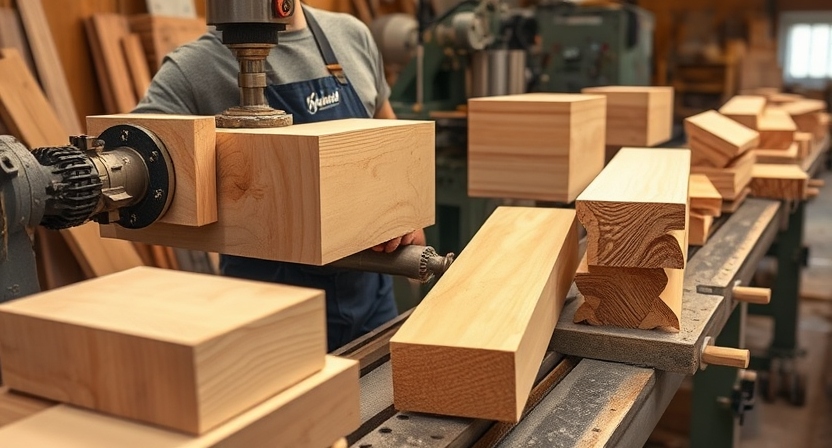
A four-side moulder is an industrial woodworking machine designed to process multiple faces of a solid-wood workpiece as it passes through the machine. Depending on its configuration and tooling, it can plane, size and profile timber to produce consistent components for furniture, doors, frames, mouldings and other wood products.
Its main advantage is process consolidation. Instead of machining each face in separate operations, a suitable four-side moulder can perform several operations during one controlled pass.
How Does a Four-Side Moulder Work?
A four-side moulder feeds timber continuously through a series of cutter units positioned around the workpiece.
The exact arrangement varies by machine, but the cutters are configured to machine the required faces and profiles as the material moves through the equipment.
A typical process can include operations such as:
- Establishing flat reference surfaces
- Sizing the workpiece to required dimensions
- Planing multiple faces
- Creating edge profiles
- Producing decorative or functional mouldings
The machine’s feed system moves the timber through each machining stage in sequence. Tooling, machine setup and the starting condition of the timber determine the resulting dimensions and profile.
Why Use a Four-Side Moulder Instead of Separate Machines?
The primary reason is to combine related machining operations into a more continuous workflow.
Consider a solid timber component that needs its faces planed and its edges shaped. Processing those requirements on separate machines can involve repeated handling, repositioning and setup.
A four-side moulder can bring several of these operations together.
This can be particularly useful when a factory produces repeated components that need consistent dimensions or profiles across a production batch.
However, a four-side moulder does not eliminate every other woodworking process. Timber may still require ripping, crosscutting, CNC machining, drilling, sanding or finishing before the component is complete.
Four-Side Moulder Applications in Solid Wood Processing
The four-side moulder is primarily associated with solid timber and dimensional component production.
Its usefulness becomes clearer when considering actual products.
Furniture Components
Furniture factories may use moulding equipment for rails, frame components, structural parts and other elongated solid-wood pieces.
For example, a rectangular timber blank can be processed into a consistently dimensioned component before it moves to CNC machining, drilling, joint preparation or sanding.
Door and Frame Components
Door manufacturing often requires repeatable solid-wood sections with controlled dimensions and specific profiles.
Four-side processing can prepare rails, stiles, frame pieces and related components for subsequent manufacturing stages.
Mouldings and Profiled Timber
The machine can also produce linear profiles where the same shape needs to continue along the workpiece.
The resulting profile depends on the cutter arrangement and tooling rather than simply on the fact that the machine processes four sides.
Planing and Moulding Are Related but Not Identical
Planing primarily creates flat surfaces and controls dimensions. Moulding introduces a particular shape or profile.
A four-side machine may perform both functions when configured appropriately.
For a basic furniture component, the objective might be to create straight, dimensionally consistent faces. For another product, cutters may produce grooves, rebates, rounded edges or decorative profiles.
This flexibility is one reason four-side moulders occupy an important position within solid wood processing equipment used for industrial furniture and component manufacturing.
The required tooling should always be selected for the actual material, profile and production task.
What Happens Before Four-Side Moulding?
A four-side moulder usually operates as one stage within a larger solid-wood workflow.
Raw or previously prepared timber may first need to be ripped to suitable widths or crosscut to appropriate lengths. The exact preparation sequence depends on the factory, material and product.
Material condition also matters. Excessively irregular stock or unsuitable dimensions can affect how efficiently the next machining stage works.
For this reason, manufacturers should define the condition in which timber enters the moulder as carefully as they define the desired finished profile.
What Processes Come After Moulding?
A moulded component is not necessarily a finished component.
Furniture parts may move to CNC machining when they need joints, holes, pockets, contours or other detailed features. Drilling or boring can create assembly points, while sanding prepares surfaces for later finishing.
A typical sequence might therefore involve initial timber preparation, four-side moulding, secondary machining, sanding and finishing.
The exact route depends on the product rather than a universal factory layout.
What Should Manufacturers Consider When Choosing a Four-Side Moulder?
Machine selection should begin with the component rather than with the machine specification sheet.
Manufacturers should consider the dimensions of the timber entering the process, required finished dimensions, profile complexity, material characteristics and expected production volume.
Working width and thickness capacity must accommodate the intended components. Feed characteristics should suit the production requirement, while spindle and cutter configurations need to support the required machining operations.
Tooling availability is equally important because the cutter profile ultimately determines many of the shapes the machine can produce.
Factories should also consider dust extraction, material handling, maintenance access and how the moulder connects with upstream and downstream equipment.
Is a Four-Side Moulder the Same as a Planer?
Not exactly.
A planer is generally associated with creating flat, dimensionally controlled surfaces. A four-side moulder can perform planing functions, but it may also use configured cutters to produce profiles on multiple faces during the same pass.
The distinction matters when selecting machinery.
If the production requirement is limited to a simpler surfacing operation, specialized planing equipment may be sufficient. When components require repeatable multi-face sizing and profiling in a continuous process, a four-side moulder may be more appropriate.
Where Does the Four-Side Moulder Fit in a Modern Factory?
The machine fits most naturally into production environments that repeatedly process elongated solid-wood components.
It can act as a bridge between initial timber preparation and more detailed downstream operations. Ripping and crosscutting establish suitable blanks; four-side moulding creates controlled dimensions and profiles; CNC machining, drilling, sanding and finishing then add the remaining component features.
The key is to view the four-side moulder as part of a complete manufacturing sequence rather than as an isolated machine. When its cutter configuration, capacity and feed system match the components being produced, it provides an efficient way to turn prepared solid timber into accurately dimensioned and profiled parts ready for the next stage of woodworking.