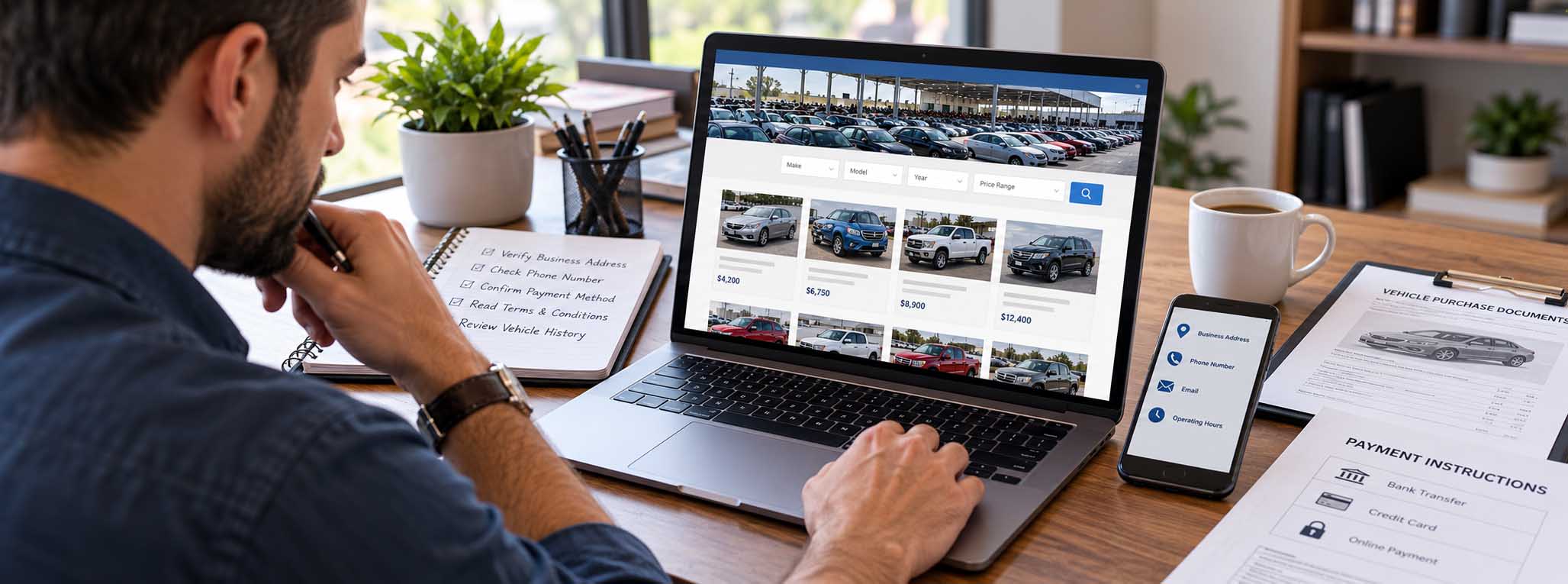
Knowing how to verify an online car auction website is essential before registering, placing bids, or transferring money for a vehicle. Although legitimate automotive auctions operate online, fraudulent websites and impersonation schemes can expose buyers to financial losses.
A professional-looking website is not enough to establish that an auction business is legitimate. Instead, buyers should independently confirm its legal identity, business contact information, vehicle listings, payment instructions, and transaction policies.
Most importantly, never send payment solely because a website displays professional photographs, customer testimonials, or attractive vehicle prices.
A careful verification process helps buyers identify inconsistencies before committing funds.
Why You Should Verify an Online Car Auction Website
Online vehicle auctions allow buyers to research inventory and participate in sales without necessarily visiting a physical location.
However, remote transactions can make it harder to confirm who operates a website and whether advertised vehicles are genuinely available.
Fraudulent operators may use copied vehicle photographs, misleading business names, or payment instructions that direct money to unrelated accounts.
Some scammers also impersonate established automotive businesses.
Therefore, verifying the actual company behind a website matters more than judging its appearance.
How to Verify an Online Car Auction Website Step by Step
A reliable verification process combines independent business research with careful examination of the proposed transaction.
No single check guarantees legitimacy. Instead, buyers should look for consistent information across multiple sources.
1. Confirm the Business’s Legal Identity
Start by identifying the company name displayed on the auction website.
Then, search the relevant state’s official business registration database.
Check whether the company name, registration status, and available business information match the website’s claims.
However, business registration alone does not prove that a website belongs to the registered company.
Fraudsters may misuse legitimate business names. Therefore, additional verification remains necessary.
2. Check the Website’s Official Domain
Website impersonation presents a significant concern in online transactions.
Scammers may create domains that resemble legitimate business websites by changing letters, adding words, or using unfamiliar domain extensions.
For example, buyers researching the Auction Center LLC website should independently verify whether the linked domain currently belongs to, or has authorization from, that legal business before relying on its identity or payment instructions.
This process should include checking the company’s independently confirmed contact information and comparing it with the website’s published details.
A domain name or hyperlink alone never proves business ownership.
3. Verify Physical Address and Contact Information
A legitimate business should generally provide enough information for customers to understand whom they are dealing with.
Look for a business address, telephone number, and clear contact procedures.
Next, compare those details with independent business records.
If an address appears to belong to an unrelated company or cannot be reasonably verified, investigate further.
Likewise, be cautious when a seller communicates only through messaging applications and refuses reasonable identity verification.
However, the absence of a public storefront does not automatically indicate fraud because some businesses operate primarily online.
Verify Online Car Auction Terms Before Registering
Clear transaction policies are another important part of website verification.
Before creating an account or paying a deposit, determine whether the website explains its bidding rules and buyer responsibilities.
Important information includes:
- Buyer eligibility requirements
- Registration and deposit policies
- Auction fees and payment deadlines
- Vehicle inspection opportunities
- Title and ownership documentation
- Pickup and transportation procedures
- Refund and dispute policies
If important terms are missing or contradictory, request clarification before proceeding.
In addition, keep copies of relevant documents and communications.
How to Verify Online Car Auction Vehicle Listings
Fraudulent auction websites may advertise vehicles they do not own or control.
Therefore, buyers should examine listing information carefully.
Check Vehicle Identification Numbers
Request the Vehicle Identification Number (VIN) when appropriate.
Then, compare it with available ownership records, vehicle history information, and supporting documentation.
A VIN alone does not prove that the seller has legal authority to sell the vehicle.
However, inconsistencies may justify further investigation.
Examine Photographs and Descriptions
Look for inconsistencies between photographs, mileage information, vehicle specifications, and descriptions.
A reverse-image search may help identify photographs that someone copied from unrelated listings.
However, reused photographs do not conclusively establish fraud because the same vehicle may legitimately appear across multiple automotive platforms.
Confirm Vehicle Availability
Ask whether you can inspect the vehicle or verify its existence independently.
If the seller cannot arrange an inspection, determine what documentation supports the listing.
Be particularly cautious when a seller refuses reasonable verification while demanding immediate payment.
Verify Online Car Auction Payment Details
Payment verification is one of the most important safeguards in an online vehicle purchase.
Before transferring funds, confirm the recipient’s identity through independently verified business contact information.
Do not rely exclusively on bank details that appear in an email, invoice attachment, or messaging conversation.
Scammers may alter payment instructions through impersonation or compromised communications.
Common Payment Warning Signs
Potential warning signs include:
- Requests to send money to an unrelated individual
- Sudden changes to bank account information
- Pressure to pay before reviewing transaction documents
- Demands for gift cards or cryptocurrency without credible justification
- Refusal to provide a clear invoice or purchase agreement
- Payment requests through channels inconsistent with the stated business identity
Legitimate vehicle businesses sometimes accept bank transfers. Therefore, the payment method alone does not establish fraud.
The critical issue is whether the buyer has independently verified the recipient and transaction.
Understand HTTPS and Website Security
A website using HTTPS encrypts information that travels between the browser and website.
However, HTTPS does not establish that the business itself is trustworthy.
Fraudulent websites can also obtain valid security certificates.
Therefore, buyers should treat HTTPS as a basic technical safeguard rather than proof of business legitimacy.
In addition, avoid submitting sensitive financial information through suspicious links or unfamiliar payment forms.
What the FTC Recommends About Online Scams
The Federal Trade Commission (FTC) provides consumer guidance about online shopping scams, payment fraud, and business impersonation.
Its guidance on online shopping scams explains how consumers can research sellers, recognize suspicious payment requests, and respond to potential fraud.
For vehicle auction buyers, these principles reinforce the need to verify business identities and payment recipients independently.
Buyers who suspect fraud can also report incidents through the FTC’s official reporting channels.
However, reporting a scam does not guarantee recovery of lost funds.
Acting quickly after discovering suspicious payment activity may improve the opportunity to seek assistance from the financial institution involved.
How to Verify a Suspicious Car Auction Website
If you cannot verify important information, stop the transaction until you resolve the concerns.
Avoid sending additional funds or personal documents.
If you have already made a payment, contact your bank or payment provider immediately.
Explain the situation and ask whether the provider can recall, dispute, or otherwise investigate the transaction.
In addition, preserve invoices, payment records, website screenshots, emails, and messages.
These records may help financial institutions or authorities review the incident.
Steps to Take Before Making Any Payment
Before completing a transaction, confirm the following:
- The legal business name matches independently available records.
- The website’s relationship to that business has credible supporting evidence.
- Contact details match information from independent sources.
- The seller can provide reasonable vehicle and ownership documentation.
- The auction terms clearly explain fees, payment deadlines, and buyer responsibilities.
- The intended payment recipient matches the verified transaction arrangements.
If any essential detail remains unclear, seek clarification before sending money.
Frequently Asked Questions
How Can You Tell If an Online Car Auction Is Legitimate?
Verify the company’s legal identity, independently confirmed contact information, auction policies, vehicle documentation, and payment recipient.
No single indicator establishes legitimacy.
Is an Online Auction Website Safe Because It Uses HTTPS?
No. HTTPS provides connection encryption but does not prove that the website operator is legitimate.
Should You Pay an Auction Deposit Before Seeing the Vehicle?
Some legitimate auctions require deposits.
However, buyers should verify the provider, understand deposit terms, and review available vehicle information before paying.
Can Scammers Use Real Business Names?
Yes. Fraudsters may impersonate registered companies or use similar website addresses.
Therefore, independent confirmation of the website’s relationship to the business is essential.
Final Thoughts
Learning how to verify an online car auction website helps buyers make safer decisions before transferring money or sharing sensitive information.
Business registration, domain identity, contact details, vehicle documentation, and payment instructions all deserve careful examination.
Although no verification process can eliminate every risk, checking information through independent sources can reveal inconsistencies that deserve attention.
Before sending payment, confirm the business identity, vehicle transaction, and intended payment recipient through reliable, independent channels.