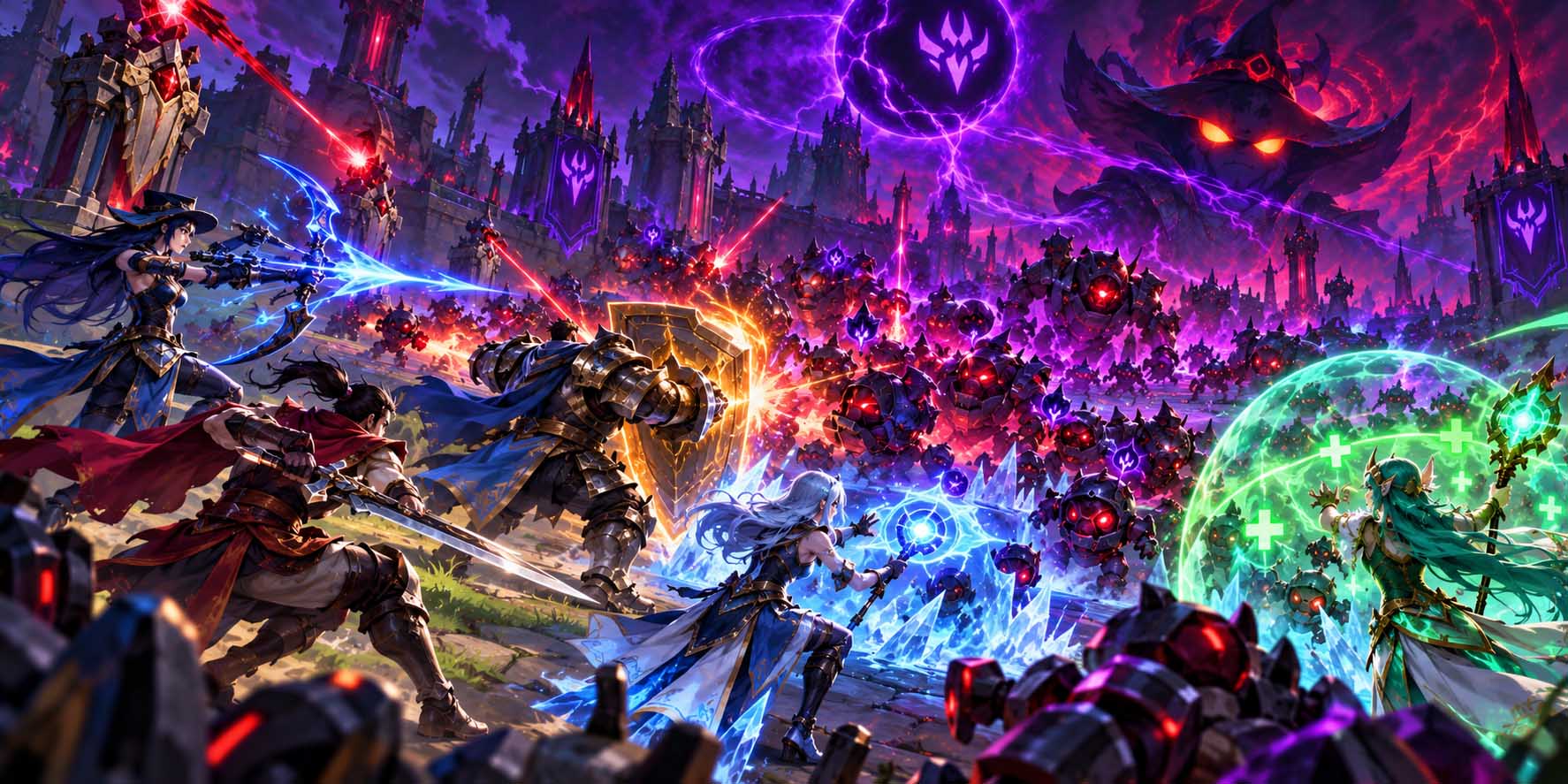
A good Doom Bots Trials strategy requires players to adapt champion priorities instead of assuming the same picks will always provide the same value. Trials and Curses can change the conditions a team must overcome, which may increase the importance of survivability, wave clear, mobility, crowd control, sustained damage, or utility depending on the challenge.
That means champion strength in Doom Bots is contextual. A pick that performs well under ordinary conditions may become less convenient when a Trial creates a different problem, while another champion’s particular strengths may become more useful.
What Are Trials and Curses in Doom Bots?
Trials add challenge conditions that can change how a Doom Bots run needs to be approached.
Curses are part of this broader challenge structure and can alter the pressure players experience during the mode. Instead of treating every run as an identical test, teams may need to adjust how they survive, position, deal damage, or coordinate.
This matters for champion selection because every champion has different strengths.
Some excel at clearing groups. Others offer durability, mobility, sustained damage, crowd control, or team protection.
When the conditions change, the relative usefulness of those strengths can change as well.
Why Doom Bots Trials Strategy Requires Flexible Picks
A rigid champion strategy assumes that the same characteristics are equally valuable in every situation.
Trials challenge that assumption.
If a particular condition makes survival more difficult, defensive tools may become more important. If the challenge increases pressure from groups, reliable AoE and wave clear may deserve greater priority.
Other conditions may make positioning, mobility, or sustained damage more valuable.
The key principle is simple: identify what the Trial makes harder, then select champions whose kits help solve that problem.
This is more useful than starting with a favorite champion and trying to force that pick into every challenge.
Survivability Can Rise in Priority
When a Trial increases the difficulty of staying active, survivability becomes more valuable.
This does not mean teams necessarily need five highly defensive champions.
Instead, players should consider how each pick avoids or withstands pressure.
A melee fighter might rely on durability and sustain. A ranged champion may survive through distance and positioning. A utility pick might protect teammates through shields, healing, or control.
These are different forms of survivability.
The important question is whether the team can continue performing its core roles when the Trial places additional strain on normal defensive resources.
If several champions become ineffective as soon as pressure increases, the composition may be too fragile for that particular challenge.
Wave Clear May Become a Higher Priority
Some Doom Bots situations can place significant pressure on a team’s ability to manage groups.
When that happens, champions with reliable AoE damage become more attractive.
Efficient wave clear helps prevent enemies from accumulating into a larger problem. It can also reduce the amount of time the frontline spends absorbing pressure and give the team more freedom to reposition.
However, players should avoid building an entire composition around one requirement.
A team with excellent wave clear but poor sustained damage or survivability may solve early pressure only to struggle elsewhere.
Trials reward adaptation, but adaptation still needs balance.
Crowd Control Can Compensate for Difficult Conditions
Damage is not the only way to manage increased pressure.
Crowd control can reduce how many threats the team must handle at the same time.
Slows, roots, stuns, Doom Bots Trials strategy knockups, and zoning effects can create valuable space when enemies become difficult to manage directly. A controlled group is easier for AoE champions to damage and less able to pressure fragile teammates.
This makes CC particularly useful when a Trial increases the consequences of poor positioning.
Instead of relying exclusively on greater damage, the team can use control to create safer damage opportunities.
Utility works similarly. Shields, healing, movement assistance, and protective abilities can help teammates continue functioning under conditions that would otherwise force them away from combat.
Mobility Can Become More Valuable Under Certain Challenges
Mobility is another characteristic whose value can change depending on the Trial.
A champion with reliable repositioning tools may have an easier time responding when safe areas become limited or when threats require frequent movement.
Mobility can help melee champions enter and leave dangerous positions. It can also allow ranged champions to preserve distance when enemies approach.
Still, mobility should be evaluated alongside the champion’s other contributions.
A highly mobile champion that offers little wave clear, damage, control, or utility may not automatically become the best option simply because movement is useful.
The strongest picks combine relevant mobility with another function the team needs.
Champion Rankings Should Change With the Conditions
Tier lists are useful because they organize champion strengths into an accessible comparison. However, challenge modifiers make it important to understand why a champion is highly rated rather than treating every ranking as permanent.
A champion might rank well because of exceptional wave clear. Another may be valued for sustained damage, frontline durability, or crowd control.
When a Trial emphasizes one of those qualities, its practical importance can increase.
For that reason, a League of Legends Doom Bots tier list is most useful when players interpret the rankings alongside the requirements of the Trial they are attempting.
The goal is not simply to choose the highest-listed champion. It is to choose a strong champion whose advantages match the current challenge.
Team Composition Matters More Than One Perfect Pick
Trials can encourage players to search for one champion capable of solving the entire challenge.
In practice, team composition provides more flexibility.
One champion can handle frontline pressure while another supplies AoE wave clear. A ranged damage dealer can provide consistent DPS while a control-focused champion limits enemy movement. Utility can support everyone through protection or sustain.
This distributes responsibilities.
It also prevents the team from becoming dependent on one champion performing several incompatible jobs at once.
When evaluating a Trial, players should therefore ask what the five-player composition collectively needs rather than searching only for the strongest individual pick.
Avoid Overcorrecting for a Single Curse
Adapting does not mean abandoning every general Doom Bots principle whenever a Curse changes one part of the run.
Overcorrection can create new weaknesses.
For example, if survival becomes more difficult, choosing too many defensive champions may leave the team without sufficient damage. If wave pressure becomes the main concern, stacking AoE specialists may weaken performance against tougher individual targets.
A better approach is to strengthen the area affected by the challenge while preserving the team’s essential functions.
Most balanced compositions still need some combination of:
- Wave clear
- Sustained damage
- Survivability
- Crowd control
- Frontline presence
- Utility
Trials can change how heavily each quality should be prioritized, but they rarely make every other function irrelevant.
Adapt Builds as Well as Champion Choices
Champion selection is only one part of adaptation.
Item choices can also support the needs created by a Trial.
A champion facing heavier pressure may benefit from additional survivability. An ability-focused pick may value more frequent access to important control or utility tools. A damage dealer may need a setup that supports consistent output rather than only a short burst window.
Players should avoid treating their standard build as fixed.
Instead, the build should reinforce the reason the champion was selected for the Trial.
If the champion’s job is to survive frontline pressure, itemization should help it remain active. If the pick is responsible for repeated wave clear, the build should support reliable use of that strength.
Ask What the Trial Changes Before Choosing
A practical Doom Bots Trials strategy begins with one question:
What does this challenge make harder than usual?
Once that is clear, champion priorities become easier to identify.
If survival is the problem, look for dependable defensive tools. If groups are overwhelming the team, prioritize wave clear and control.
Then check whether the rest of the composition still covers its essential responsibilities.
This approach is more reliable than assuming one champion or one fixed team will be ideal for every variation.
Trials and Curses are reasons to evaluate champion strengths dynamically. By matching survivability, damage, control, mobility, wave clear, and utility to the conditions of the run, teams can build around the challenge they are actually facing rather than the one they expected.