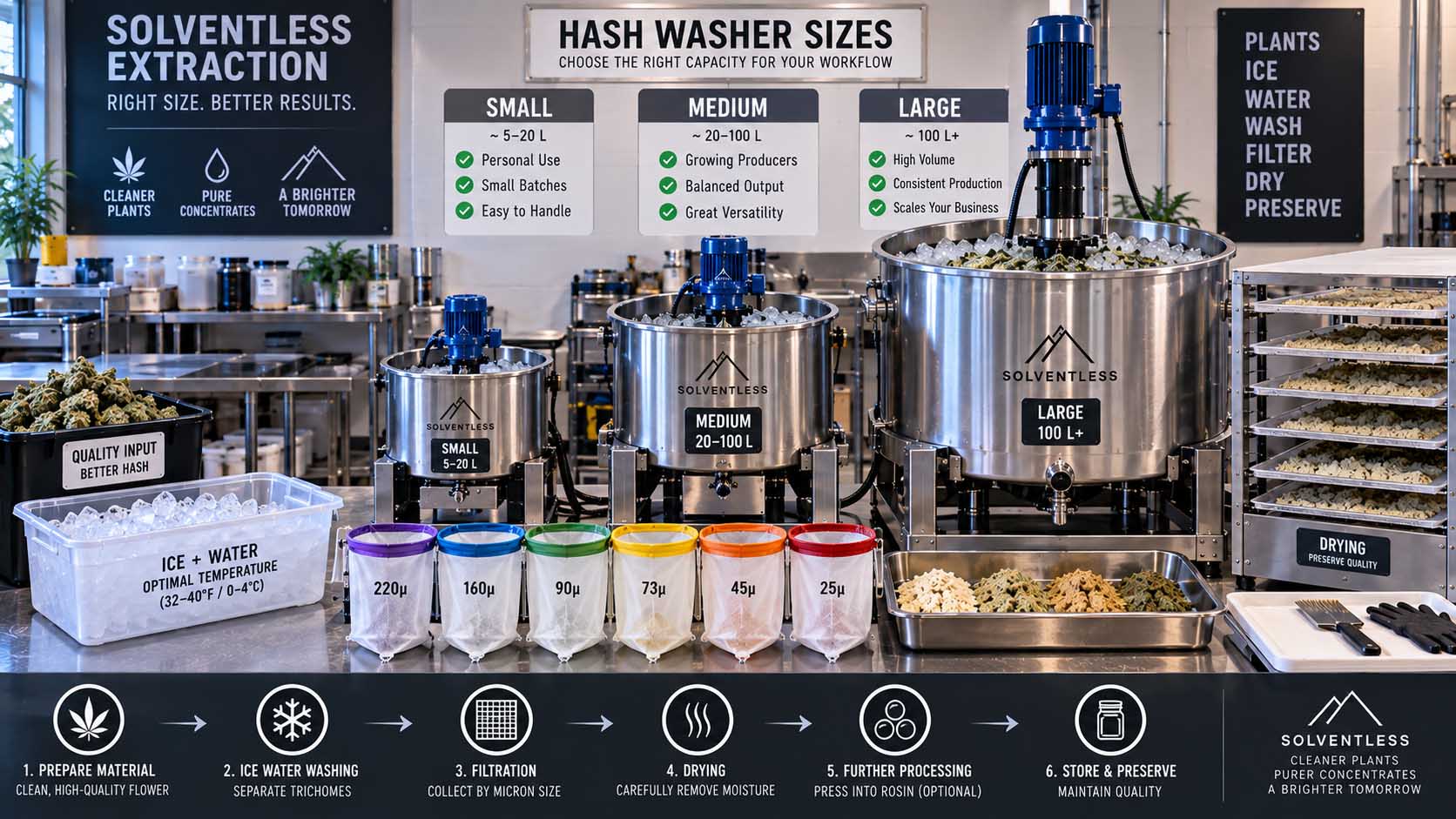
Choosing the right hash washer size means matching the washing vessel to your real batch volume, processing frequency, workspace, filtration system and drying capacity. A larger washer is not automatically more efficient. The best size is one that lets material move smoothly through the entire solventless workflow without overwhelming the stages that come after washing.
For a professional setup, washer capacity should therefore be evaluated as part of the complete ice-water hash process rather than as a standalone specification.
What Does Hash Washer Size Tell You?
Hash washer size generally refers to the capacity of the washing vessel. However, that number should not be treated as the exact amount of cannabis material that can be processed in every batch.
Ice-water hash washing requires enough space for cannabis material, cold water, ice when used, and controlled movement inside the vessel.
The practical working load can therefore depend on several factors, including the type and condition of the starting material and the washing procedure being used.
Rather than focusing only on vessel capacity, processors should ask how the equipment will perform with their normal batches.
Match Hash Washer Size to Your Typical Batch
Start with the amount of material you actually expect to process.
If most production runs involve relatively small batches, oversized equipment may consume valuable workspace without providing a meaningful advantage. On the other hand, repeatedly dividing larger amounts of material into many small washes can increase labor and extend processing sessions.
Consider:
- Typical amount of material available for each production run
- Number of batches processed in a day
- Frequency of washing sessions
- Need to keep cultivars or batches separate
- Number of wash cycles performed on material
- Staff available for washing and collection
These operational details provide a better basis for equipment selection than choosing the largest available washer.
Consider Fresh Frozen and Dried Material Workflows
The form of the starting material can also influence production planning.
Fresh frozen cannabis and dried material may enter a solventless workflow differently. Storage, preparation, batch organization and timing can all affect how much material is ready for washing at one time.
A facility that receives larger quantities of prepared material may benefit from a different washing capacity than a small operation working through limited batches.
Therefore, washer sizing should reflect how material actually reaches the washing station.
Washing Capacity Must Match Filtration Capacity
After agitation separates trichomes from plant material, the resin-containing water must move into filtration.
Bubble bags or other micron filtration systems are commonly used to separate and collect resin fractions. This stage requires time, workspace and appropriate equipment.
If a washer produces more material than the filtration station can efficiently handle, increasing washing capacity may simply create a queue after each cycle.
The better approach is to balance the two stages.
A washer should produce batches that the filtration system can process without unnecessary delays or disorganization.
When Does a 30-Gallon Washer Make Sense?
A medium-capacity washer can be relevant for processors who need more structured mechanical washing than a small manual setup while still wanting equipment that fits into a manageable professional workspace.
When evaluating this category, a 30-gallon hash washer should be considered in relation to actual material volume, production frequency, filtration capacity, available floor space and downstream drying requirements.
The Mini Osprey belongs to this part of the solventless workflow, where mechanical ice-water washing supports trichome separation before filtration and resin collection.
The capacity label alone, however, should not determine whether this size is appropriate. Its usefulness depends on how well it fits the rest of the processing system.
Do Not Size the Washer Without Considering Drying
Wet hash collected after filtration must be properly handled and dried.
This means drying capacity can become a major constraint when washing throughput increases.
For example, a facility may have enough material and labor to run additional wash batches, but that extra capacity provides limited practical value if all available drying space is already occupied.
Processors using freeze-drying equipment should similarly consider how washing schedules align with available freeze-dryer capacity.
A balanced workflow connects:
Washing → filtration → resin collection → drying → further processing or storage
Each stage should be able to handle the output of the previous one.
Measure Your Processing Space
Physical workspace is another important consideration when choosing hash washer size.
The washer needs sufficient room for safe operation, but the surrounding workflow also requires space for water, ice, filtration bags, collection containers, tools and cleaning.
Consider how material will physically move through the room.
The path from washing to filtration should be straightforward, and staff should have enough space to work without constantly moving equipment.
Drainage and cleaning access should also be considered when planning the washing area.
A washer that technically fits into a room may still be too large if it makes the rest of the process difficult to manage.
Think About Cleaning Between Batches
Production capacity is not only about how quickly material can be washed.
Equipment must also be emptied and cleaned as required between batches. Operations handling several cultivars or separately tracked batches should include cleaning and changeover time when estimating daily throughput.
A larger vessel can process more material in the right workflow, but it can also require a different cleaning routine than a smaller system.
Therefore, processors should evaluate the complete cycle:
Preparation → washing → draining → filtration → collection → cleaning → next batch
This gives a more realistic picture of useful daily capacity.
Should You Buy a Larger Washer for Future Growth?
Some additional capacity can make sense when production is expected to grow, but excessive oversizing may not provide immediate value.
Instead, identify the current bottleneck.
If hand washing or a small vessel is limiting production while filtration and drying have unused capacity, increasing washer size may improve the overall workflow.
If filtration or drying is already operating near its practical limit, buying a substantially larger washer may only move the bottleneck to another stage.
Future growth should therefore be planned across the entire processing system.
Choose Capacity as Part of a Complete Solventless Setup
The right hash washer size depends on more than the amount of cannabis that fits inside a vessel. Batch volume, washing frequency, starting-material workflow, filtration capacity, drying resources, cleaning procedures, staff availability and physical workspace all affect the decision.
A well-matched washer should help material move predictably from ice-water agitation through trichome filtration and drying without creating unnecessary delays elsewhere.
By sizing washing equipment around actual production needs rather than maximum capacity alone, a solventless processor can build a more balanced setup that works efficiently today while leaving practical room for future growth.