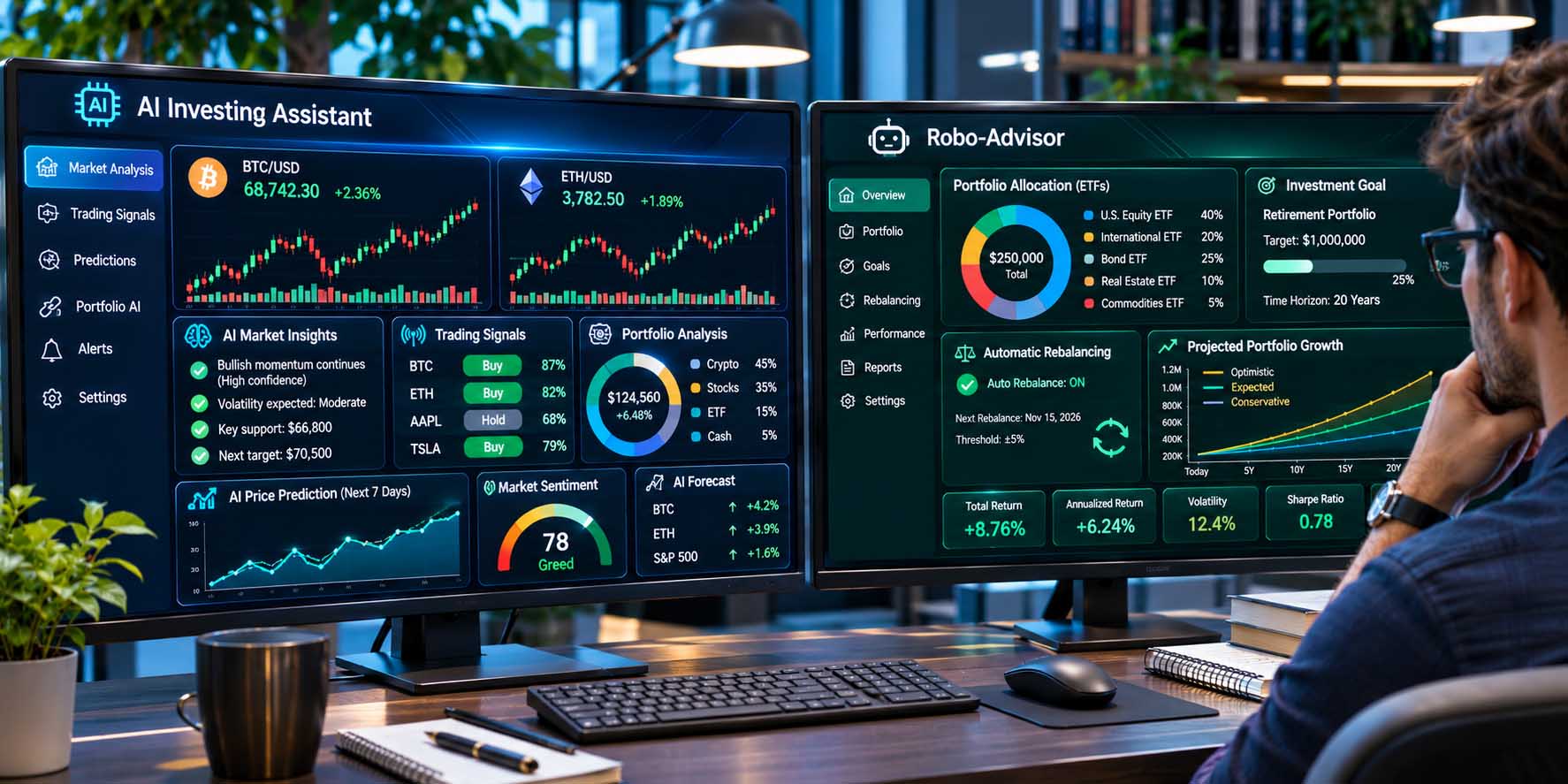
AI investing assistants vs robo-advisors is an increasingly relevant comparison for investors seeking digital tools to simplify financial decisions. Both technologies can automate parts of the investment process, but they generally serve different purposes.
AI investing assistants often focus on market analysis, trading insights, and decision support. Robo-advisors typically concentrate on portfolio construction, asset allocation, and ongoing investment management.
However, the distinction is not absolute. Some robo-advisors use artificial intelligence, while certain AI investing platforms offer portfolio monitoring or automated trading capabilities.
Understanding what each service actually automates helps investors select tools that match their financial objectives.
What Is an AI Investing Assistant?
An AI investing assistant is a software system that uses artificial intelligence to analyze financial information and support investment-related decisions.
Depending on its design, an assistant may examine stock prices, cryptocurrency markets, exchange-traded funds, economic indicators, or portfolio activity.
Common capabilities include:
- Analyzing market trends and price movements.
- Generating potential trading signals.
- Monitoring investment portfolios.
- Identifying changes in market volatility.
- Summarizing financial information.
- Highlighting concentration or exposure risks.
- Providing analytical insights based on available data.
Some AI assistants simply present information for investors to evaluate.
Others may integrate with trading infrastructure to support automated transactions.
Therefore, the term AI investing assistant does not automatically imply discretionary investment management or independent authority to execute trades.
What Is a Robo-Advisor?
A robo-advisor is a digital investment service that uses software to provide portfolio recommendations or manage investments according to defined objectives.
Many robo-advisors begin by collecting information about an investor’s financial goals, investment horizon, and risk tolerance.
The service may then recommend a diversified portfolio containing assets such as stocks, bonds, or ETFs.
Depending on the provider, robo-advisors can automate:
- Portfolio allocation.
- Scheduled investment contributions.
- Portfolio rebalancing.
- Dividend reinvestment.
- Tax-loss harvesting.
- Progress monitoring toward investment goals.
Unlike tools focused primarily on short-term market analysis, robo-advisors often emphasize long-term portfolio management.
However, available services differ, and not every robo-advisor provides all these features.
AI vs Robo-Advisors: Main Differences
Understanding AI assistants vs robo-advisors helps investors compare market analysis tools with automated portfolio management services.
The central difference concerns the type of investment work each technology performs.
| Feature | AI Investing Assistants | Robo-Advisors |
|---|---|---|
| Primary purpose | Market intelligence and decision support | Portfolio management |
| Typical investment focus | Stocks, crypto, ETFs, and market analysis | Diversified long-term portfolios |
| Trading signals | May generate predictive insights | Usually not the main service |
| Portfolio rebalancing | Depends on the platform | Common feature |
| Automated transactions | Available in some systems | Common in managed accounts |
| Investment personalization | Depends on inputs and product design | Often based on goals and risk profiles |
| Human involvement | Varies by automation level | Often limited after initial setup |
| Regulatory responsibilities | Depend on services provided | Managed advisory services may require registration |
These distinctions describe typical product categories rather than universal rules.
Investors should examine the actual features and legal status of individual providers.
How AI Investing Tools Support Trading Decisions
AI investing assistants may help investors interpret large amounts of market information.
For example, an investor monitoring Bitcoin, Ethereum, and several technology stocks might use an AI system to identify unusual volatility or changes in price momentum.
The assistant could highlight relevant developments without requiring the investor to examine every chart manually.
Some platforms also combine multiple analytical models to assess market conditions.
For example, Hyperlyx AI describes a multi-model trading intelligence approach focused on market analysis and trading-related insights.
Investors exploring this type of technology can review https://hyperlyx.co to understand its stated analytical capabilities.
However, users should independently verify available features, product status, execution permissions, and performance evidence.
An AI platform’s ability to generate market insights does not necessarily mean it provides regulated financial advice or discretionary portfolio management.
Robo-Advisors vs AI Tools for Portfolio Management
Robo-advisors generally automate recurring portfolio tasks rather than attempting to predict every short-term market movement.
Automated Asset Allocation
Asset allocation determines how investment capital is distributed among different asset categories.
For example, a robo-advisor might recommend a portfolio containing stock and bond ETFs based on an investor’s stated objectives.
The allocation may reflect factors such as investment horizon and tolerance for market fluctuations.
Portfolio Rebalancing
Portfolio rebalancing restores investment allocations toward their intended proportions.
Suppose an investor begins with a hypothetical portfolio containing 60% stocks and 40% bonds.
If stock prices increase significantly, the portfolio might shift toward 70% stocks and 30% bonds.
A robo-advisor may rebalance holdings according to its methodology to bring the allocation closer to the intended target.
However, rebalancing can create transaction costs and, in taxable accounts, potential tax consequences.
Automated Contributions
Some robo-advisors allow investors to schedule recurring deposits.
This can support consistent investing without requiring manual transactions every month.
Nevertheless, regular contributions do not eliminate market risk or guarantee investment growth.
AI vs Robo-Advisors for Passive Investors
Choosing between AI vs robo-advisors depends on whether investors need market insights or automated long-term portfolio management.
Passive investors generally prioritize long-term financial goals, diversified portfolios, and limited day-to-day involvement.
For these investors, a robo-advisor may be suitable when they want automated portfolio management based on predefined objectives.
An AI investing assistant may be more useful when they want additional information about market developments or existing investment exposure.
For example, a passive ETF investor might use a robo-advisor for recurring contributions and rebalancing while consulting an analytical tool for broader market context.
However, additional trading signals are not necessarily beneficial for someone following a long-term passive investment strategy.
Frequent reactions to market fluctuations can introduce unnecessary transactions and costs.
AI Investing Tools vs Human Financial Advisors
AI investing assistants can automate certain analytical tasks, but they do not necessarily replace qualified financial professionals.
Personalized financial advice may involve tax considerations, retirement planning, estate planning, insurance needs, and complex financial circumstances.
An AI system may lack complete information about these factors.
Additionally, the regulatory status of an AI investment service depends on its activities and jurisdiction.
In the United States, for example, providing investment advice for compensation may trigger investment adviser registration requirements unless an exemption applies.
Investors should verify whether a provider offers general information, personalized recommendations, or regulated advisory services.
Choosing Between AI and Robo-Advisors
Before selecting either type of platform, investors should consider several practical questions.
What tasks does the service automate? Determine whether it provides analysis, recommendations, transaction execution, or full portfolio management.
Who controls investment decisions? Understand whether the investor must approve trades or the provider can act independently.
What are the costs? Review subscriptions, advisory fees, trading commissions, and other expenses.
How are assets held? Identify the custodian, brokerage, or exchange responsible for holding investments.
What risks remain? Consider market losses, technical failures, inaccurate predictions, and potential conflicts of interest.
Clear answers help investors distinguish useful automation from marketing terminology.
Conclusion
AI investing assistants and robo-advisors automate different aspects of investing.
AI assistants commonly emphasize market intelligence, trading analysis, and decision support. Robo-advisors generally focus on portfolio allocation, rebalancing, and long-term investment management.
Although their capabilities can overlap, neither category is automatically superior.
The appropriate choice depends on whether an investor needs analytical assistance, managed portfolio services, or a combination of both.
Ultimately, investors should evaluate each platform’s actual responsibilities, fees, regulatory status, and limitations before relying on automated investment technology.